
Corporate Tax for Foreign Companies in Qatar: Rules & Obligations
Qatar is one of the easiest places in the Gulf to do business, but it is not tax-free for everyone. If your company has foreign owners and earns
Details
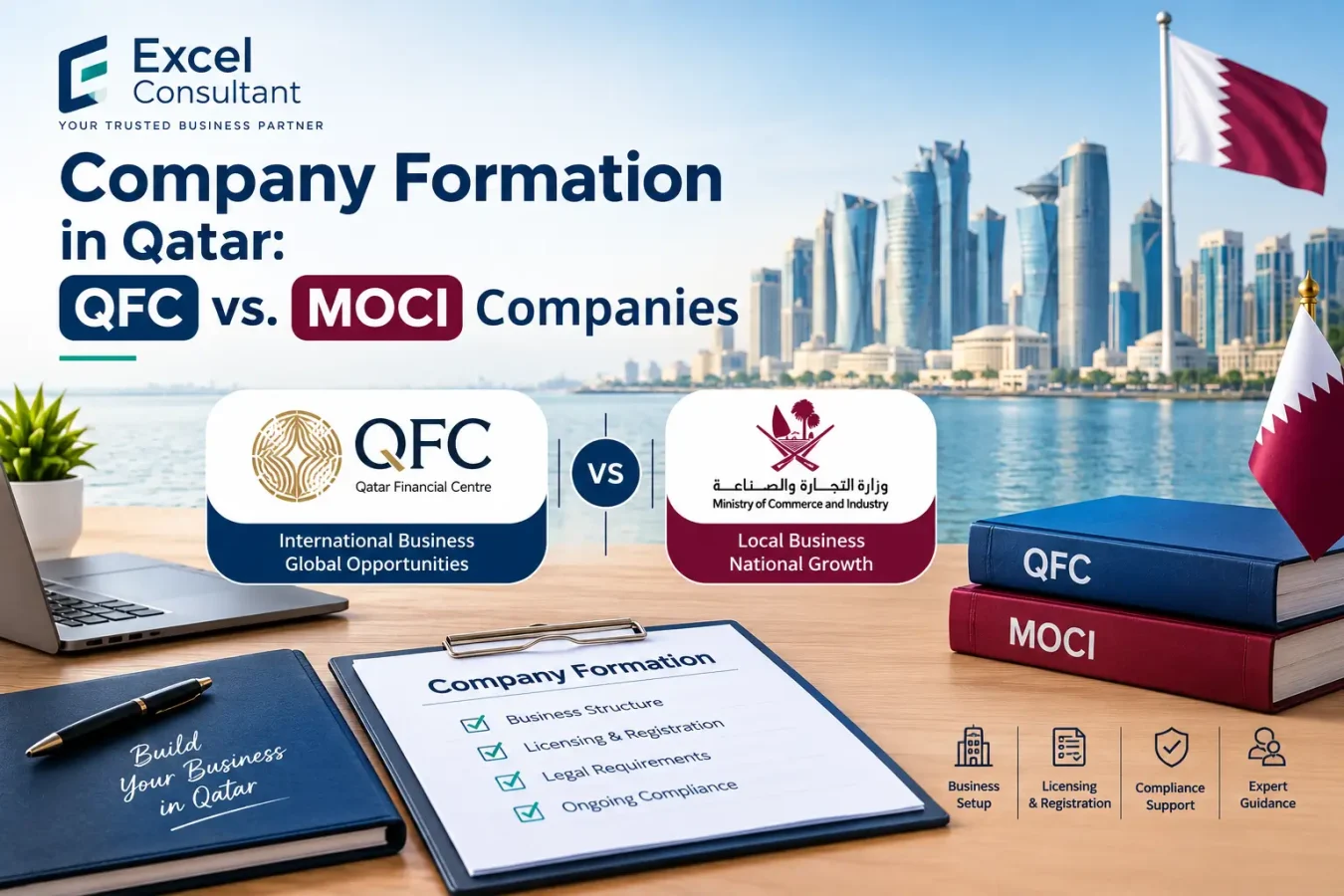
Starting a business in Qatar offers exciting opportunities for local and international investors. However, choosing the right business structure and registration authority is an important decision. Two common options for businesses are the Qatar Financial Centre (QFC) and companies registered through the Ministry of Commerce and Industry (MOCI).
Understanding the differences between QFC vs. MOCI Companies can help entrepreneurs choose the right setup based on their business activities, ownership requirements, taxation, and growth plans.
The Qatar Financial Centre (QFC) is a business and financial centre that provides a legal and regulatory framework for companies operating in Qatar. It is particularly attractive to professional services, financial services, consulting, technology, and other internationally oriented businesses.
QFC companies benefit from an international-style legal framework and can be suitable for businesses looking to operate in Qatar while serving local and international clients.
Companies registered through the Ministry of Commerce and Industry (MOCI) operate under Qatar’s commercial laws and regulations. MOCI is the primary government authority responsible for commercial registration and licensing for many businesses in Qatar.
MOCI company formation can be suitable for businesses involved in trading, contracting, retail, manufacturing, general services, and other commercial activities.
When comparing QFC vs. MOCI Companies, entrepreneurs should consider several important factors.
One of the first considerations is the type of business activity.
QFC is particularly suitable for professional and specialized services, including consulting, accounting, legal services, financial services, technology, and other permitted activities.
MOCI provides a broader commercial framework covering many traditional business activities, including trading, contracting, retail, manufacturing, and services.
The permitted activities can differ depending on the exact business model, so investors should verify the applicable activity before starting the registration process.
Ownership requirements can vary depending on the business activity and applicable regulations.
QFC provides an attractive framework for international investors and can offer 100% foreign ownership for eligible businesses.
MOCI companies may also allow full foreign ownership for eligible activities under Qatar’s investment framework. However, requirements can depend on the nature of the business and applicable approvals.
Therefore, ownership should be assessed based on the specific activity rather than assuming that one structure is always better.
Taxation is another important consideration when evaluating QFC vs. MOCI Companies.
QFC businesses operate under the QFC tax regime, while companies registered through MOCI are generally subject to Qatar’s applicable tax laws and regulations.
The tax treatment can depend on factors such as business activity, ownership, income sources, and applicable exemptions or incentives. Businesses should obtain professional tax advice before choosing a structure.
QFC companies operate under a separate legal and regulatory framework administered by QFC authorities.
MOCI-registered businesses operate within Qatar’s wider commercial and regulatory framework.
This distinction can affect company registration, licensing, contracts, compliance obligations, and ongoing administration.
Business location and office requirements are also important during company formation.
QFC businesses generally need to meet QFC requirements regarding their registered office and business operations.
MOCI companies may have different premises, municipality, licensing, and commercial requirements depending on their business activity.
Entrepreneurs should consider the location requirements before finalizing their company structure.
There is no single option that is best for every business. The right choice depends on your business activity, ownership plans, target market, operational requirements, and long-term objectives.
QFC may be suitable if you:
MOCI may be suitable if you:
A professional assessment before registration can help you avoid choosing a structure that does not match your business activity.
The exact documentation depends on the selected structure and business activity. However, entrepreneurs may generally need documents such as:
Additional documents may be required for specific activities or foreign investors.
Company formation involves more than obtaining commercial registration. Entrepreneurs must consider licensing, taxation, accounting, regulatory compliance, corporate documentation, and ongoing reporting requirements.
A business consultancy can help compare QFC vs. MOCI Companies, identify the appropriate structure, prepare documentation, and guide investors through the formation process.
Professional guidance can also help businesses understand their post-registration obligations and maintain compliance as they grow.
Choosing between QFC and MOCI is an important step when establishing a business in Qatar. The comparison of QFC vs. MOCI Companies should take into account business activities, ownership, taxation, regulatory requirements, office requirements, and long-term business objectives.
Whether you are establishing a professional services company, trading business, consultancy, or another commercial venture, selecting the appropriate registration framework can create a stronger foundation for your business.
For personalized guidance on company formation in Qatar, speak with experienced business consultants who can evaluate your requirements and help you select the appropriate structure.
QFC (Qatar Financial Centre) is designed primarily for financial and professional services and operates under its own legal and regulatory framework. MOCI (Ministry of Commerce and Industry) handles the registration and licensing of businesses under Qatar’s broader commercial framework. The better option depends on your business activity, ownership structure, and target market.
Yes, 100% foreign ownership may be available under both structures, subject to the applicable business activity, legal requirements, and approvals. QFC generally permits full foreign ownership for eligible QFC activities, while MOCI companies may also qualify for full foreign ownership in permitted sectors.
There is no single answer. QFC can be more suitable for companies providing financial, consulting, professional, and other eligible services. MOCI is often more appropriate for businesses involved in commercial, trading, industrial, or other activities regulated through Qatar’s mainland commercial system.
Requirements vary according to the company type and jurisdiction. Generally, applicants may need passport copies, proposed company name, business activity details, incorporation documents, shareholder information, and proof of address. Additional documents or approvals may be required depending on the activity and ownership structure.
The timeline depends on the business activity, company structure, document readiness, and required approvals. QFC and MOCI registration processes can differ significantly, so having the correct documents and selecting the appropriate business structure from the beginning can help avoid unnecessary delays.
Qatari Business Owners, Entrepreneurs, and Business Managers get in touch with Excel Consultants & Partners LLC now for a free consultation.
Get free consultation!Qatar is one of the easiest places in the Gulf to do business, but it is not tax-free for everyone. If your company has foreign owners and earns
DetailsA letter from the General Tax Authority can make any business owner nervous. However, a tax audit in Qatar does not have to be stressful. With the right
DetailsRunning a business in Qatar comes with many perks. Low tax rates and no personal income tax on salaries are two of the biggest. But low taxes do
Details
Qatari Business Owners, Entrepreneurs, and Business Managers get in touch with Excel Consultants & Partners LLC now for a free consultation on Accounting Training & Education, Bookkeeping, Audit, Tax, Qatar VA, Business Plans & Feasibilities, HR Consultancy for Accounting, Qatar VAT & VAT Training, Accounting for Ecommerce, and Project Management.